What elocution actually involves
English is a difficult language to utter with assurance. It is not written as it is spoken, its spelling is a museum of historical accidents, and its rhythm does more work than most learners realise. The alphabet has twenty-six letters; spoken British English has roughly forty-five distinct sounds, including around twenty vowel sounds alone: the short vowels of fish and cat, the long vowels of tree and horse, and the diphthongs of train and cheer, where two vowel sounds are joined inside a single syllable. Most speakers who feel their accent lets them down are struggling with a handful of these, not with English as a whole.
But individual sounds are only the beginning. Speech is not a series of separate words: sounds run into one another, some are weakened, some disappear entirely, and English is unusual in how heavily it leans on stress and intonation to carry meaning. Where you place emphasis can change a sentence from a statement into a question, from courteous into curt. A great deal of what people call "having an accent" is in fact this music — the rise and fall, the pacing, the pauses — rather than the vowels themselves. It is also the part most self-study apps ignore, because it cannot be drilled from a list.
Your voice, not a new one
Let me be plain about the remit of this work. I have no interest in erasing where you are from, and you should be wary of anyone who offers to. Your accent is part of your identity, and it carries your history with it. What we work on is clarity and control: making sure that what you intend to say is what your listener receives, and giving you the ability to move up and down the register at will — more formal for the boardroom, more relaxed for the pub — rather than being stuck in one gear.
For some people that means softening a strong accent so colleagues stop asking them to repeat themselves. For others — and this is a request I take entirely seriously — it means learning Received Pronunciation properly, because they want to speak with the elegance and authority that the English establishment still, rightly or wrongly, responds to. Both are legitimate. Both are learnable.
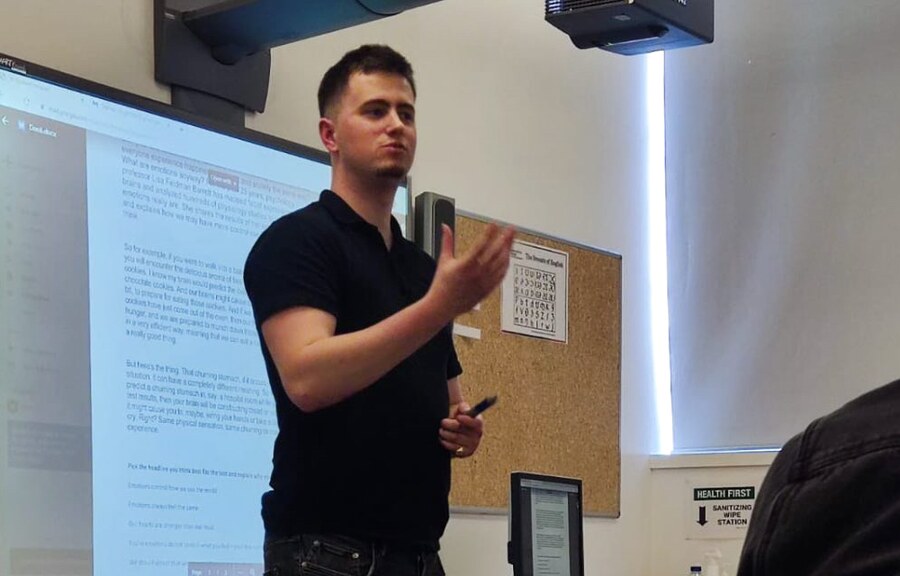
Teaching in the classroom: the same close attention applies in a 1-to-1 online lesson.
Who this tends to suit
- Professionals who are tired of being asked to repeat themselves in meetings
- Non-native speakers whose English is already strong, but whose pronunciation lags behind their vocabulary
- British speakers who want to soften a regional accent for a public-facing role, or simply for their own confidence
- Those who want to acquire Received Pronunciation deliberately, for professional, social or performance reasons
- Anyone who speaks in public — presentations, lectures, interviews, toasts — and wants to be heard properly
Why learn it from me
There is no shortage of pronunciation apps, and there are agencies with rosters of voice coaches. What I offer is narrower and, I think, more useful: one person, teaching a form of English he actually grew up speaking. I was educated at Winchester College, often regarded as the finest school in the country, where precise, articulate speech is ambient rather than timetabled. I hold a Cambridge CELTA, a BA and an MSc in psychology, and I have taught English one-to-one for over five years. I also spent the better part of a year as a writing specialist training frontier AI models in written English, which was daily practice at hearing precisely where a sentence goes wrong.
That psychology background does a great deal of the work. Most people who come to me for accent work have ability in abundance and confidence in short supply, and they are carrying some embarrassment about the whole subject. Half of this work is technical: sounds, stress, intonation. The other half is making somebody comfortable enough to experiment out loud in front of another person. I am unhurried, I do not correct every syllable, and nothing you say in a lesson with me will be met with impatience.